


- Details
- Category: Uncategorised
-
 By Brian
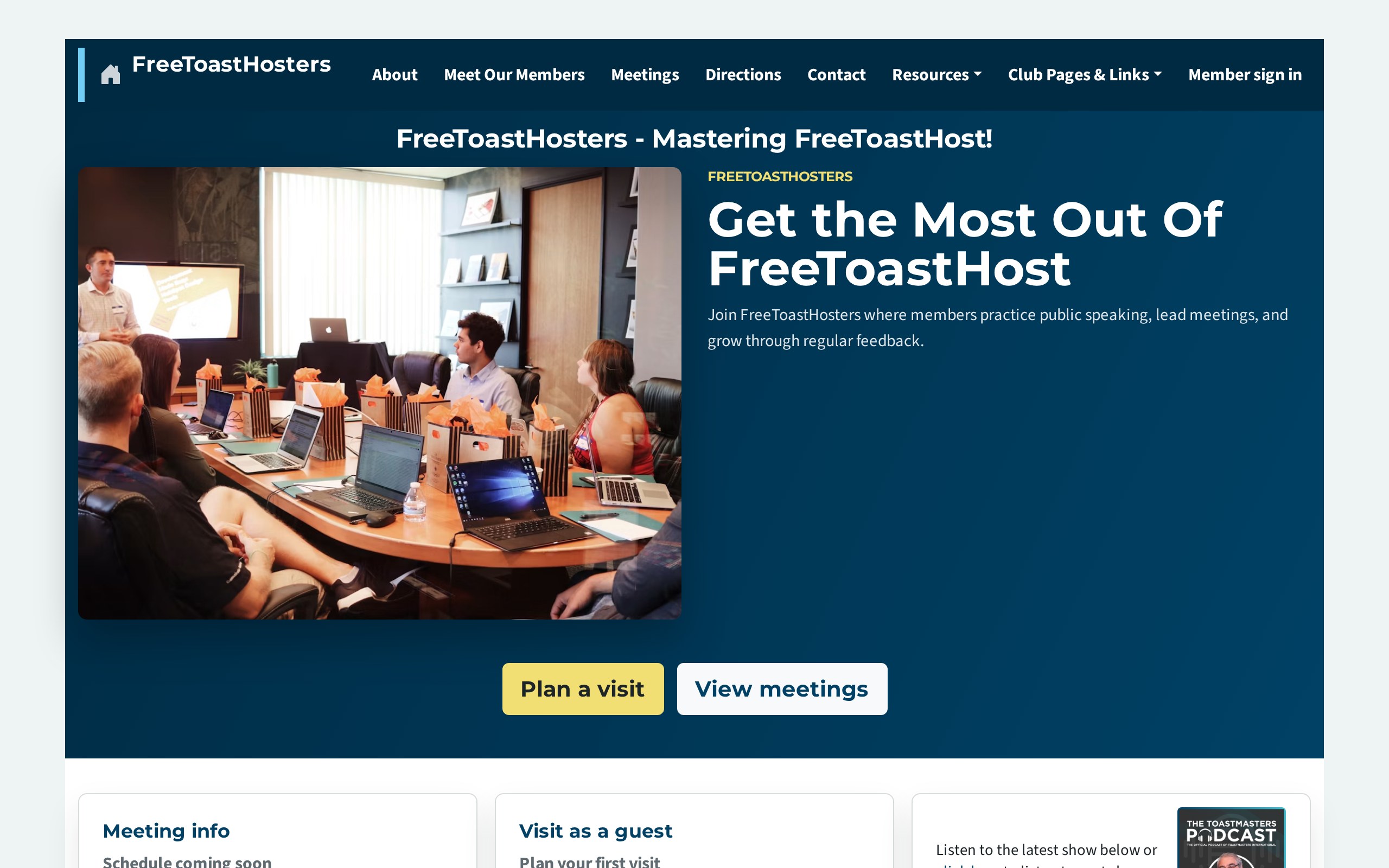
In January 2004 we introduced FreeToastHost to the Toastmasters community. Since that time, FreeToastHost has been helping clubs attract new members, operate more efficiently, and keep current members informed and engaged. Over 11,000 Toastmasters clubs around the world benefit from the no-cost websites and online tools provided by FreeToastHost — including the meeting agenda, member directory, e-mail lists, and club calendars.
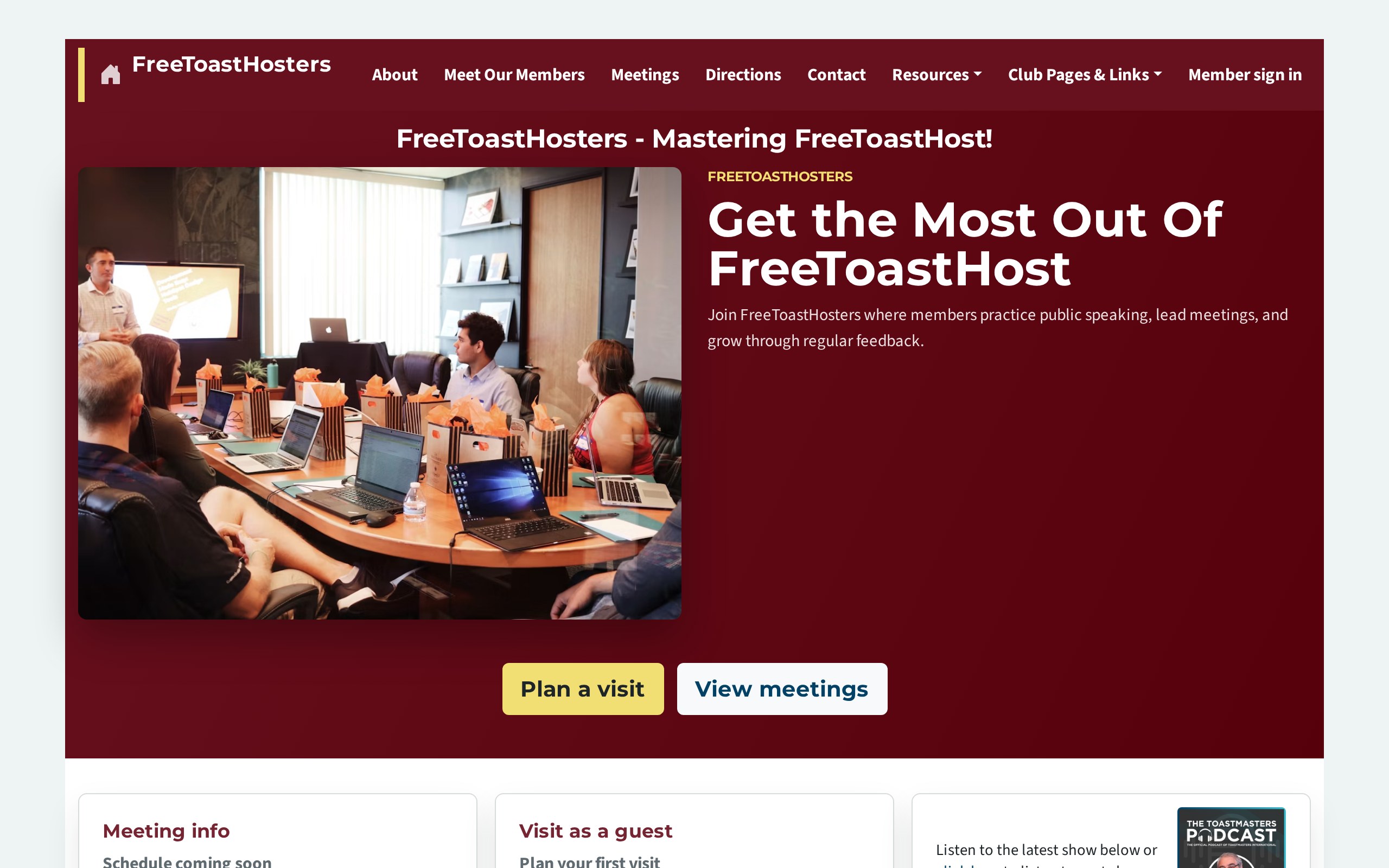
In August 2011 we introduced FreeToastHost 2, a generational update to the platform. In August 2018, FreeToastHost 3 brought fully responsive templates and updates to support the EU GDPR privacy laws.
Now we are proud to introduce FreeToastHost 4 — a complete, ground-up rebuild. FTH4 delivers a modern mobile-first interface, a streamlined meeting agenda system, a redesigned member management suite, Pathways-aware speech tracking, and a fresh public website for every club and district. FreeToastHost is built and maintained by Toastmasters volunteers, with the cooperation of Toastmasters International. Providing your club is listed on Toastmasters.org, there is no cost for this service.
Every website includes
- A public club or district site at your own web address, in your choice of TI brand colours.
- Meeting agendas with role sign-ups, printing, email, reports and role forecasting.
- Member directory, club email addresses and mailing lists.
- Pathways progress, speech history and club member recognition. (Clubs only)
- Club or district calendar and dues tracking. (Dues tracking is clubs only)
- Custom pages, file library and photo storage.
- Details
- Category: Blog
-
By FreeToastHost
FreeToastHost (FTH) provides club websites that members, officers, and prospective members depend on. Keeping those websites available and protecting access to club information requires controls against spam, automated attacks, and other misuse.
FTH does not support access through VPN services, and many VPN IP addresses are blocked because of misuse. If your club website works when your VPN is off but fails when it is on, the VPN connection may explain the problem. FTH's existing support guidance confirms this policy.
Problems with VPNs
A virtual private network, or VPN, routes your connection through another server. The website you visit generally sees that server's public IP address rather than your usual internet connection's address. Many VPN services allow numerous customers to share the same outgoing address.
That shared address is central to the problem. One customer may be updating a meeting agenda while another uses the same address to send spam, test stolen passwords, or probe websites for weaknesses. A website cannot establish that everyone using an address is trustworthy simply because one person is a legitimate club member. Some abusive requests also arrive before anyone signs in.
When an address is blocked because of misuse, legitimate customers sharing it can also lose access. We recognize that this is inconvenient. A block does not mean that FTH has accused you personally of wrongdoing; the problem may be activity associated with the connection you share.
VPNs and criminal activity
The connection between VPN services and criminal activity is well documented. In June 2026, the FBI reported that First VPN allegedly supported at least 25 ransomware groups, which used its infrastructure for network reconnaissance and intrusions. The service's addresses were also used for scanning, scams, and other malicious activity. Read the FBI's account.
Free VPN applications introduce another concern. Some have been used to turn users' computers into residential proxies: devices that relay someone else's traffic through an ordinary household internet connection. In the 911 S5 investigation announced in May 2024, the U.S. Justice Department alleged that malware was distributed through programs including MaskVPN and DewVPN, alongside other software distribution methods. Access to infected computers was then sold to criminals to conceal their activity. Read the Justice Department's announcement.
The FBI issued a further warning in March 2026 that some free VPN services may enroll users' devices in residential proxy networks without meaningful consent. These networks can support account attacks, malware distribution, and the transfer of stolen data. In such cases, someone installing a VPN for privacy may unknowingly supply infrastructure used against other people.
These examples do not establish that every VPN is unsafe or that VPN popularity caused the overall increase in data breaches. VPNs have legitimate uses, and price alone does not establish whether a service is trustworthy. Paying for a VPN also does not guarantee that its shared IP addresses will be accepted by FTH.
Protecting the FTH website service
FTH's policy addresses a practical responsibility: protecting the service against misuse. Blocking addresses associated with abuse can stop traffic before it consumes website resources or reaches account functions. It is one protective measure, and it does not replace secure software, strong passwords, or other safeguards. Removing a block simply because a VPN customer requests access could also restore access for others using that address.
Members sometimes assume that disconnecting a VPN means their website connection will no longer be encrypted. HTTPS provides encryption between your browser and the website independently of a VPN. Use your club's correct HTTPS address and do not proceed past certificate warnings. HTTPS does not provide every privacy feature a VPN offers, but a VPN is not required for that browser-to-website encryption. Learn how HTTPS works.
If you cannot reach your club website:
1. If you control the VPN and can disconnect it, turn it off and try the website again using its HTTPS address.
2. Try a trusted alternative connection, such as your home internet connection or a personal mobile hotspot.
3. If your employer requires a VPN or security gateway, ask your IT team about an approved way to access FTH. Keep required workplace protections in place.
4. If access still fails, contact FTH Support. Include your club number, website address, exact error message, whether a VPN is active, and your current public IP address so the team can investigate. A review does not guarantee that an address will be unblocked.
A timeout alone does not prove that your VPN is blocked or that FTH is down. Follow the website access troubleshooting guidance so support can identify the cause.
Conclusion
FTH's priority is reliable access to club websites while reducing opportunities for misuse. Members can help by using a direct, trusted connection and providing clear information when an access problem needs investigation.
- Details
- Category: Blog
-
By Peter Baumgarten
On Wednesday and Thursday, October 28 & 29, 6:30 - 8 pm EDT,
Join FTH Ambassador Peter Baumgarten for a ZOOM training session to introduce FreeToastHost 4 and answer your questions.
The sessions will open at 6:10 pm. Space is ZOOM-limited to 100 participants per session and registration does not guarantee entry. Sign in early to secure your spot.
Latest Forum Posts
-
- Uploading images
- In Public Forums / FTH4 Support
- 10 hours 29 minutes ago
-
- Agenda sign up, member name menu
- In Public Forums / FTH4 Support
- 11 hours 34 minutes ago
-
- Managing Agenda, role sign up
- In Public Forums / FTH4 Support
- 12 hours 48 minutes ago
-
- Speechcraft Projects and Evaluations in Agenda
- In Public Forums / FTH4 Suggestions and Improvements
- 12 hours 56 minutes ago
-
- Need to Remove a Pathway from Pathway Report Card
- In Public Forums / FTH4 Support
- 14 hours 33 minutes ago