Where in the documentation is the "#1", "#2", "#3" notation explained?
I did not find it here:
https://support.toastmastersclubs.org/doc/fth4/fth4-agenda-index
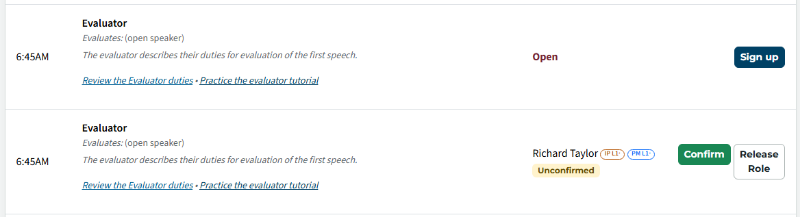
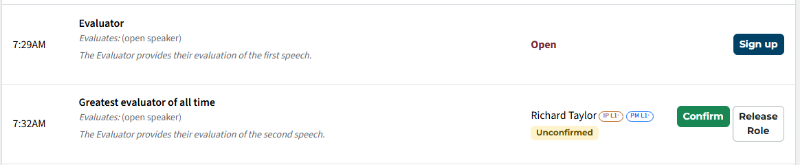
In FTH3, if I wrote "*Evaluator* #1" in two places and made the first occurrence a role that could be signed up for, and the second occurrence a role that could not be signed up for, then whoever signed up for the first occurrence was auto-filled into the second role.
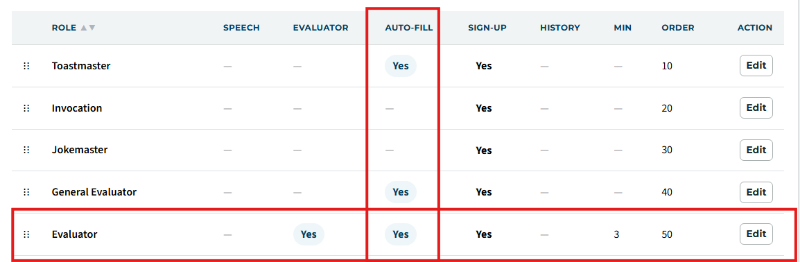
The process still seems to work. If I assign the role "Evaluator" to a row (attributes: Evaluator, Auto-Fill, Sign-up) with display name "Evaluator #1" it works the same way as in FTH3.
The documentation ( https://support.toastmastersclubs.org/doc/fth4/editing-agendas-templates ) for "Club role" states: "Links this row to a club role. When a member is assigned to any row with this role, all other rows using the same role in that meeting are filled automatically."
I interpret that to mean that the first person assigned to a club role "Evaluator" is assigned to every other "Evaluator" row. This is not how it actually works. It works the way it did in FTH3.
My club agenda has:
Evaluator #1
Introduces the project and what he will be looking for in the speech.
Speaker #1
Delivers a prepared speech.
Evaluator #2
Introduces the project and what he will be looking for in the speech.
Speaker #2
Delivers a prepared speech.
[...]
Evaluator #1
Evaluator #2
As I understand the current documentation, I need to create different roles (Evaluator1, Evaluator2, etc.), but that's not how the platform actually works.
Can someone please disambiguate this for me?
Steffan Carroll, PN-07298222
CB-04846432-Optimal Speakers
CB-00001677-Temecula Toastmasters
https://optimalspeakers.toastmastersclubs.org
https://temecula.toastmastersclubs.org
https://d203.toastmastersdistricts.org